Precision Perception
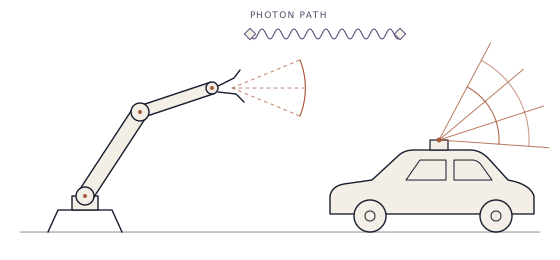
Explore photonic and quantum-enhanced sensing (optical, LiDAR-class, magnetic, and inertial) for higher-fidelity perception.

Emerging Technologies · Physical AI
Physical AI (robots, autonomous vehicles, drones, and intelligent machines that sense and act in the real world) depends on precise perception, reliable navigation, and fast decisions. Qtarang explores how quantum and photonic technologies can strengthen each of these layers.
Why It Matters
Autonomous systems must perceive accurately, know where they are without relying on external signals, and plan actions under tight energy and latency limits. Quantum sensing, photonic computing, and hybrid optimization offer new approaches worth evaluating for these constraints.
Focus Areas
Six areas where Qtarang explores, evaluates, and develops quantum and photonic approaches for machines that perceive and act.
Explore photonic and quantum-enhanced sensing (optical, LiDAR-class, magnetic, and inertial) for higher-fidelity perception.
Evaluate quantum inertial sensing, magnetometry, and precision timing for positioning where satellite signals are weak or unavailable.
Apply quantum and hybrid optimization to path planning, task allocation, and scheduling across robot and vehicle fleets.
Assess photonic and optical computing approaches for low-latency, energy-efficient processing on the machine.
Explore hybrid approaches for selected perception, control, and decision-making workloads.
Develop simulation and benchmarking workflows to test quantum-enabled capabilities against established methods before deployment.
Applications
Application areas for machines that sense and act in the real world.
Precision sensing, inspection, and multi-robot scheduling.
Perception and navigation for vehicles, drones, and marine systems.
Fleet routing, task allocation, and real-time optimization.
Resilient navigation and sensing in contested or signal-denied environments.
Our Approach
The same seven-step lifecycle Qtarang uses for every engagement, applied to autonomy problems.

Let's explore whether quantum and photonic technologies can address your perception, navigation, or optimization challenge.